2011
OPSGEAR was a small Utah-based retail company that served the military, law enforcement, and military-simulation recreation communities. Whatever the mission, duty, or game session, one thing in common across all of these diverse groups is the need to wear a duty vest that can hold a staggering variety of gear, from medical kits to weapon or ammunition pouches to radio, command, or navigation devices.
Vests can be purchased pre-configured for a particular type of duty or operation, but most prefer a modular approach, where the base vest is outfitted top to bottom only with a series of narrow straps upon which the user then adds a number of purpose-specific pouches that weave onto the straps.
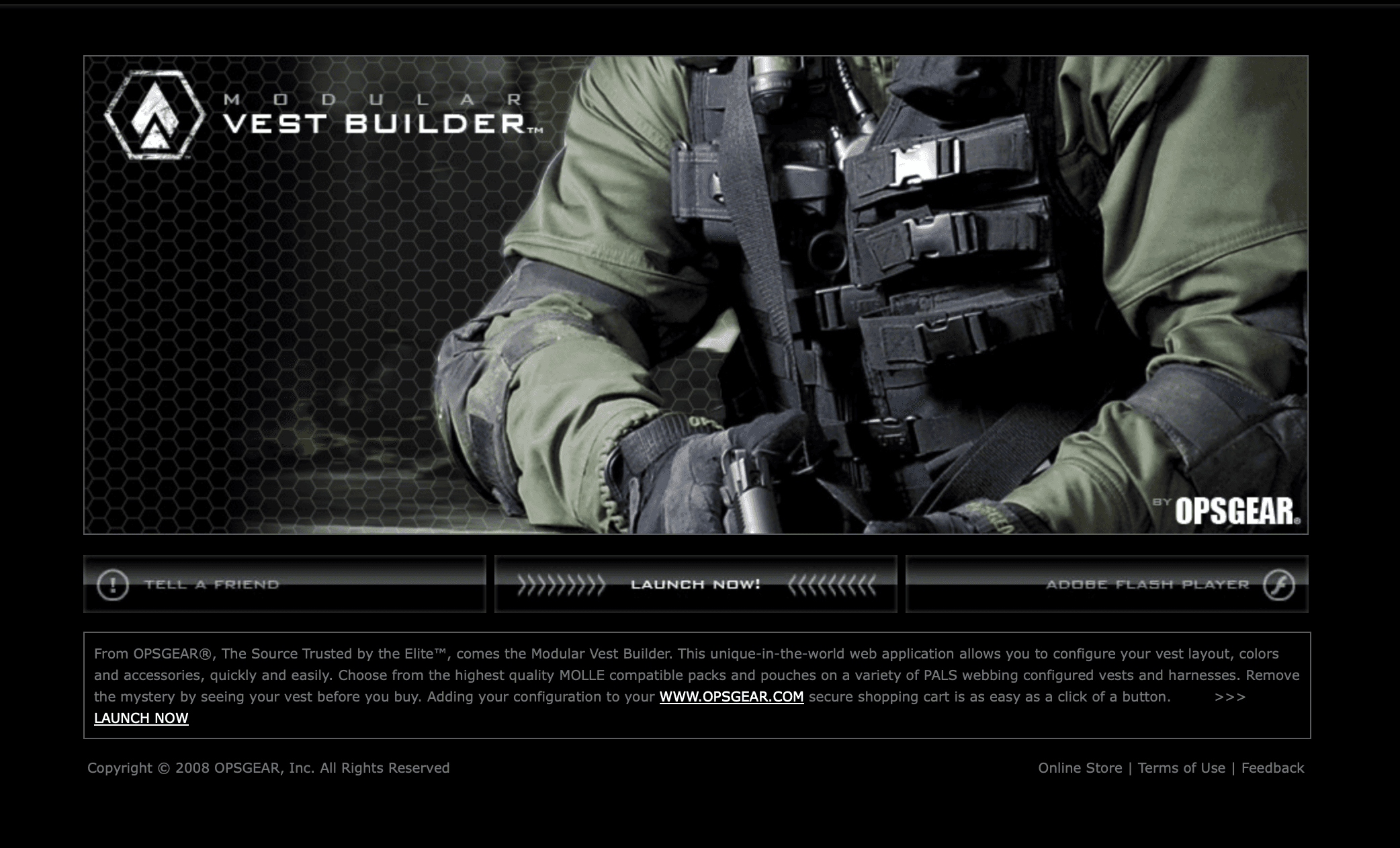
The OPSGEAR main launch page
Problem
Although OPSGEAR stocked thousands of pouches for every conceivable purpose and in every conceivable duty color, we weren't seeing the sales and adoption specific to vests and customizations that would be expected considering the steady sales in other product lines for the same markets. There seemed to be a blind spot in product awareness.
A companion theory was that to those who were experienced in purchasing and configuring a vest in person, browsing an online store isn't ideal when you can't see how the pouches of various sizes will fit together when space is limited.
Opportunities
Our solution was the Vest Builder: an interactive application that would allow the user to select a vest style and color, then add pouches and rearrange by dragging them around on screen to the exact position and fit for their needs. The main goal was to build confidence in the purchase and drive sales.
Ideation
Understanding each market required an understanding of their core goals and needs, and so we considered the potential audience in three broad personas:
Military User
May be assigned to multiple operations over career, will have different needs for each
Will need optimal vest configuration for each assignment or theater
Builder values: speed and variety of product selection
Law Enforcement User
May only make one or two long-term vest purchases over career
Needs are less likely to vary over time, so purchases are carefully considered
Vests may be fully dictated by department in configuration or color
Builder values: accuracy and product interoperability
Milsim (Military Simulation) User
Recreational users, inspired by military in popular culture to go to remote areas in groups and play competitive war games (e.g. airsoft or paintball)
More likely to make multiple purchases, different colors and configurations
Values playability from builder, ability to quickly see different colors / configurations and share and compare with teammates
Testing and Iteration
Strangely enough, much of the testing for the Vest Builder happened at unexpected times during development. The CEO of OPSGEAR was himself ex-military, and the retail store attracted many friends of his across military and law enforcement. He would often grab whoever was in the store at the time (maybe a Salt Lake City police officer, or an ex-Air Force Security Forces member) and bring them up to the media office to have them check out this new application we were working on.
The at-first unprompted feedback gave us some unexpected and extremely valuable insight into the needs of our target audience. After the first couple of surprise drop-ins, I insisted that anyone else in the store with a military or police background come up immediately to sit and try to configure a vest.
Key Insights
Some of the most insightful feedback included comments like:
"My department regulations say we can only wear black."
– Salt Lake City SWAT Officer
"I'm a field medic, how do I find the first aid and trauma kit pouches?"
– National Guard Member
Which led directly to the addition of new features including:
Filtering vests and pouches by color
Filtering pouches by type
Creating pre-configured options when called for by organization
The ability to email yourself a list of all of your configured items with shopping links to purchase late
To further drive sales and meet business needs, we then worked closely with our e-commerce provider to develop a custom process to allow us to add an add-to-cart button, linking directly to the online store's shopping cart, with the user's chosen vest and pouches already added and ready for purchase, reducing friction even further.
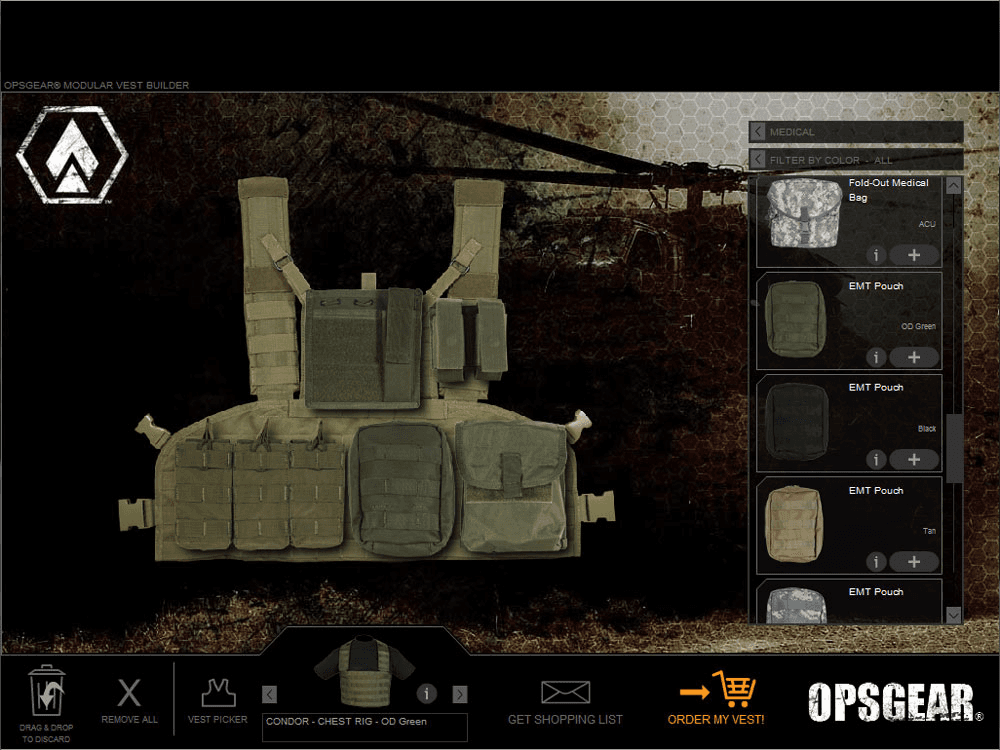
The main Vest Builder interface lets the user choose a vest to start, then customize it with pouches to haul necessary gear
Lessons Learned
As one of my first experiences designing and iterating on a user-focused product, some of my biggest early UX lessons were born from the process. Among the biggest are:
"I am not my target audience"
– UX axiom
Given my complete lack of military or law enforcement experience, I relied heavily on those early testers who gave candid, and sometimes blunt but necessary feedback that helped make a better product.
"No plan survives first contact with the enemy"
– Prussian Field Marshal Helmuth von Moltke the Elder
See also:
"Everybody has plans until they get hit for the first time"
or
"Everybody has a plan until they get punched in the mouth"
– Mike Tyson
Your best ideas and strongest designs won't amount to much if not tested and validated with actual users. Be prepared to pivot fast when new or insightful feedback comes in.
This early work reinforced the value of continuous discovery and frequent testing. The feedback from this fast-fail approach helped solve usability issues and add valuable features before launch, and the Vest Builder quickly became one of our most popular products across our commerce and media operations.